

Introduction
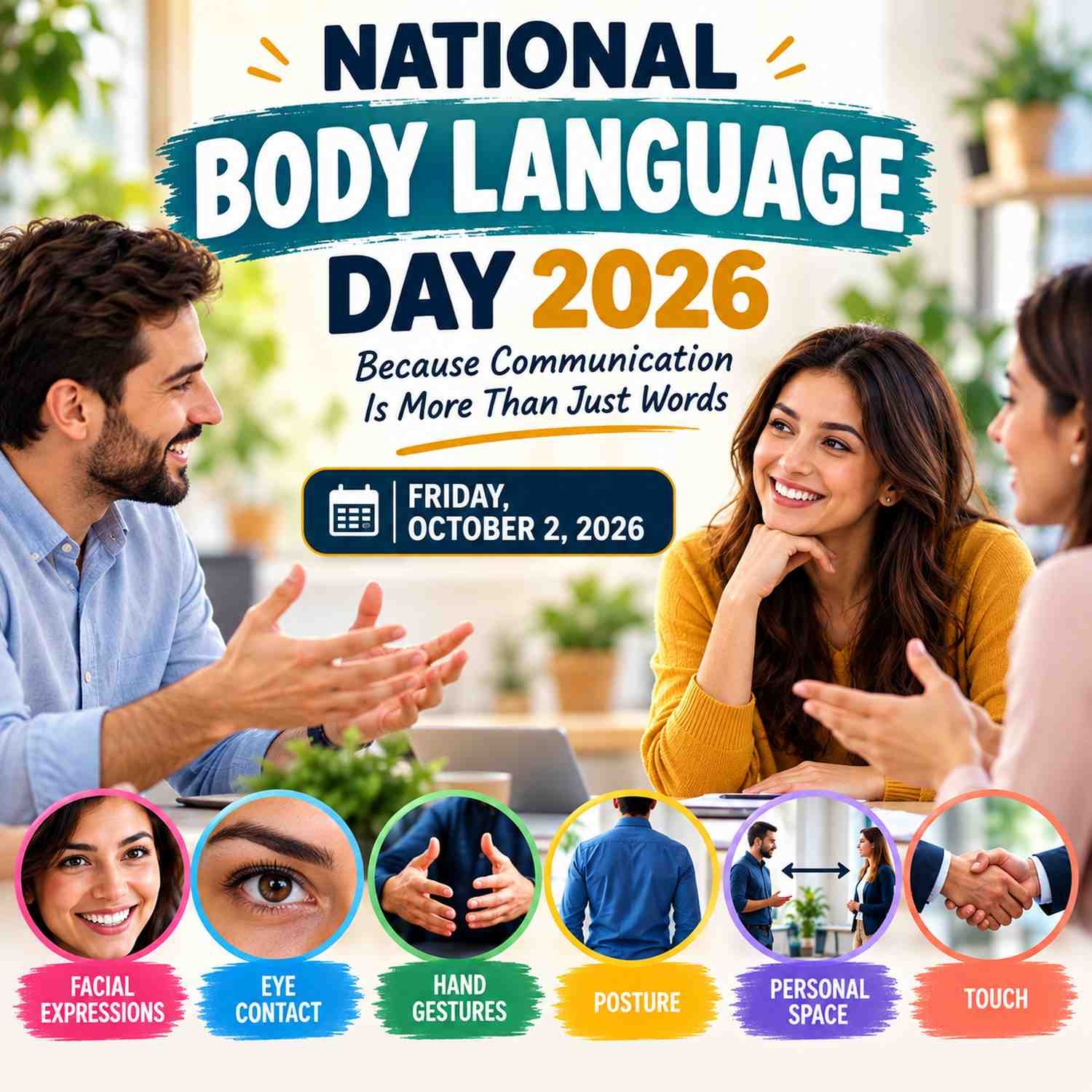
Every conversation involves more than just words. A smile, a facial expression, a hand gesture, the way someone stands, or even a change in eye contact can add another layer to communication. National Body Language Day 2026 is an opportunity to pay closer attention to these nonverbal signals and think about how they influence everyday interactions.
Also Read: National Name Your Car Day 2026: Date, History, Car Name Ideas & Ways to Celebrate
In the United States, National Body Language Day is observed on the first Friday of October each year. In 2026, it falls on Friday, October 2. The observance was established in 2018 by body language expert Blanca Cobb, founder of TruthBlazer LLC, and was proclaimed by the Registrar at National Day Calendar.
The day encourages people to become more aware of both the signals they send and the nonverbal cues they notice from others. It can be observed in simple ways, from paying attention during conversations to practicing more conscious facial expressions, posture, gestures, and listening habits.
When Is National Body Language Day 2026?
National Body Language Day 2026 is on Friday, October 2, 2026.
The date changes every year because the observance takes place on the first Friday of October. Recent dates include October 3, 2025, October 2, 2026, and October 1, 2027.
National Body Language Day Dates
| Year | Date | Day |
|---|---|---|
| 2025 | October 3 | Friday |
| 2026 | October 2 | Friday |
| 2027 | October 1 | Friday |
| 2028 | October 6 | Friday |
| 2029 | October 5 | Friday |
| 2030 | October 4 | Friday |
This makes October 2, 2026, a useful date to remember for anyone interested in communication, interpersonal skills, education, leadership, or personal development.
What Is National Body Language Day?
National Body Language Day is an annual observance that highlights the importance of nonverbal communication.
Body language can include facial expressions, gestures, posture, eye contact, movement, and the way people use physical space while interacting. These signals can accompany spoken words, reinforce a message, or sometimes communicate information without words.
The purpose of the day is not simply to learn a list of gestures and assign a fixed meaning to each one. Instead, it encourages people to become better observers and to consider body language alongside the words, situation, relationship, and cultural context.
For example, crossed arms might reflect comfort, habit, temperature, or a particular emotional state depending on the situation. Similarly, limited eye contact can have many possible explanations. A single physical cue should therefore not automatically be treated as proof of what someone is thinking or feeling.
History of National Body Language Day
National Body Language Day was established in 2018 by Blanca Cobb, a body language expert and founder of TruthBlazer LLC. The observance was created to encourage greater awareness of nonverbal communication and how people understand one another beyond spoken language. The Registrar at National Day Calendar proclaimed the day in 2018 for annual observance on the first Friday of October.
The broader study of nonverbal behavior has a much longer history. National Day Calendar notes that Charles Darwin discussed expressions and emotional behavior in his 1872 work The Expression of the Emotions in Man and Animals. Long before modern communication research, humans also relied on gestures, facial expressions, movements, and sounds to communicate needs and reactions.
National Body Language Day brings attention to this everyday form of communication and encourages people to observe it more consciously.
Why Is Body Language Important?
Body language is an important part of human interaction because communication does not happen through spoken language alone.
When people communicate, their words are accompanied by facial expressions, posture, gestures, movement, and other nonverbal behaviors. Paying attention to these elements can provide additional context for a conversation.
Here are several reasons body language matters:
1. It Adds Context to Conversations
A person’s facial expression, posture, or gestures may add context to what they are saying.
For instance, an enthusiastic tone accompanied by an energetic expression may reinforce excitement. A serious expression during an important discussion may indicate that the speaker wants the conversation to receive careful attention.
However, these cues should be considered together rather than interpreted individually.
2. It Can Support Clearer Communication
Conscious use of gestures and facial expressions can sometimes make communication easier to follow.
Teachers, presenters, speakers, and professionals may naturally use hand movements, facial expressions, and posture to emphasize important points.
3. It Can Affect First Impressions
People often form impressions during their first interaction with someone. Posture, facial expressions, eye contact, and other nonverbal behaviors can contribute to how an interaction feels.
Being aware of these signals can help people communicate more intentionally.
4. It Can Help With Active Listening
Listening is not only about remaining silent while another person speaks. Nodding, maintaining appropriate eye contact, facing the speaker, and showing attentive facial expressions can communicate that someone is engaged in the conversation.
5. It Matters in Professional Settings
Body language can be relevant during job interviews, presentations, meetings, classroom discussions, customer interactions, and workplace conversations.
Professional communication involves both what people say and how they conduct themselves during an interaction.
Common Types of Body Language
Body language includes many different forms of nonverbal communication.
Facial Expressions
Facial expressions can accompany emotions and spoken messages. Smiling, frowning, raised eyebrows, and changes in facial tension can all provide information about an interaction.
However, facial expressions should always be interpreted in context.
Eye Contact
Eye contact can play an important role in conversations. Appropriate eye contact can communicate attention and engagement, although the amount of comfortable eye contact differs among individuals and cultures.
Avoiding eye contact does not automatically mean that someone is dishonest, uninterested, or uncomfortable.
Hand Gestures
People frequently use their hands while speaking. Gestures can emphasize an idea, explain a direction, or accompany a story.
The meaning of a particular gesture can also vary between cultures, making context especially important.
Posture
The way a person sits or stands is another part of nonverbal communication. An upright posture, relaxed shoulders, or a change in physical position may influence how an interaction is perceived.
Personal Space
People have different preferences for physical distance during conversations. Personal space can also vary according to culture, relationship, environment, and situation.
Head Movements
Nodding, shaking the head, tilting the head, and other movements may accompany conversations. Their meaning should be considered alongside the words being spoken and the surrounding circumstances.
How Body Language Affects Everyday Communication
Body language is present in many ordinary situations.
Think about a conversation between two friends. One person may speak while the other nods, smiles, maintains eye contact, or changes facial expressions. These behaviors become part of the conversation even though they are not spoken words.
The same thing happens at school, work, restaurants, stores, family gatherings, and social events.
Understanding this can encourage people to become more observant communicators. Instead of focusing exclusively on what someone says, they can consider the complete interaction.
At the same time, it is important not to assume that body language provides a perfect way to read someone’s thoughts. Nonverbal cues are influenced by many factors, including personal habits, culture, physical comfort, surroundings, and the specific conversation.
National Body Language Day 2026 Celebration Ideas
You do not need a large event to celebrate National Body Language Day. The observance can be incorporated into everyday activities.
Practice Active Listening
During your next conversation, focus on listening carefully. Face the person, pay attention to their words, and notice their facial expressions and gestures without jumping to conclusions.
Try a Mirror Exercise
Stand in front of a mirror and practice different facial expressions and speaking postures.
Notice how small changes in your posture or expression can change the way your communication appears.
Play Charades
Charades is a simple and entertaining way to explore communication without spoken words. Players have to rely on gestures and movements to communicate an idea.
It can be especially fun for families, classrooms, and groups of friends.
Observe Your Own Body Language
Spend part of October 2 paying attention to your own habits.
Do you gesture frequently while speaking? Do you look at your phone during conversations? Do you change your posture when you become nervous or excited?
The goal is awareness rather than judging yourself.
Organize a Classroom Activity
Teachers can use National Body Language Day as an opportunity to introduce students to nonverbal communication.
Students could work in pairs, act out different situations, or communicate simple messages using gestures and expressions.
Practice Presentation Skills
If you regularly give presentations, record yourself speaking and observe your posture, gestures, facial expressions, and movements.
This can help you become more conscious of how you communicate in front of an audience.
Share a Body Language Fact
You can also celebrate online by sharing an interesting fact about nonverbal communication using #NationalBodyLanguageDay.
National Body Language Day Activities for Students
National Body Language Day can be particularly useful in educational settings.
Teachers can create activities that demonstrate how people communicate without speaking.
For example, students can:
- Play charades.
- Guess emotions from facial expressions.
- Practice different presentation postures.
- Create short silent scenes.
- Observe how gestures support storytelling.
- Discuss cultural differences in nonverbal communication.
- Practice active listening.
- Compare spoken messages with accompanying gestures.
These activities can make communication lessons interactive while encouraging students to think carefully about how messages are conveyed.
National Body Language Day at Work
Workplaces also provide many opportunities to discuss body language.
During meetings, employees communicate through posture, facial expressions, gestures, eye contact, and physical positioning as well as through their words.
Managers and employees can use October 2 as an opportunity to discuss respectful communication and active listening.
For example, a team could practice:
- Maintaining attentive posture during meetings.
- Avoiding distracting habits while someone is speaking.
- Using appropriate facial expressions.
- Giving speakers enough personal space.
- Paying attention to nonverbal feedback.
- Considering cultural differences.
- Asking questions instead of assuming what another person’s body language means.
The emphasis should be on clearer communication rather than trying to “decode” coworkers.
Body Language and Cultural Differences
One of the most important things to remember about body language is that not every gesture has the same meaning everywhere.
Eye contact, hand gestures, personal space, touching, facial expressions, and other behaviors can differ between cultures and individuals.
A gesture that seems ordinary in one cultural setting may have a different meaning somewhere else.
That is why context matters so much. When communicating with people from different backgrounds, curiosity and respect are more useful than making quick assumptions.
Common Body Language Mistakes to Avoid
Learning about body language is helpful, but there are also some common mistakes to avoid.
Don’t Assume One Gesture Has One Meaning
A single gesture rarely provides enough information to understand an entire situation.
Don’t Try to Read Minds
Body language can provide clues, but it cannot reliably tell you exactly what another person is thinking.
Don’t Ignore Cultural Differences
Different communities may have different expectations regarding eye contact, gestures, personal space, and physical contact.
Don’t Focus Only on Nonverbal Cues
Words still matter. Good communication involves considering both verbal and nonverbal information.
Don’t Judge Someone Too Quickly
People may have habits or circumstances that affect their body language. Nervousness, tiredness, illness, environment, personality, and cultural background can all influence physical behavior.
Interesting Facts About Body Language
Here are some interesting points to consider on National Body Language Day:
- National Body Language Day is observed on the first Friday of October.
- National Body Language Day was established in 2018.
- Blanca Cobb founded the observance.
- October 2 is National Body Language Day in 2026.
- Body language includes gestures, posture, facial expressions, eye contact, and movement.
- Nonverbal communication can accompany spoken language or communicate information without words.
- The meaning of body-language cues depends on context.
- Charles Darwin discussed emotional expressions and behavior in his 1872 work on expressions in humans and animals.
- Charades is a simple activity that demonstrates how gestures can communicate ideas without speech.
- National Body Language Day encourages people to pay attention to both their own nonverbal signals and those of others.
National Body Language Day 2026 Quotes and Messages
Looking for a short message to share on October 2? Here are some original options:
- “Sometimes communication begins before the first word is spoken.”
- “Listen to the words, notice the gestures, and understand the whole conversation.”
- “Body language is part of the conversation, so pay attention to what you communicate without words.”
- “A thoughtful gesture can add meaning to a thoughtful message.”
- “National Body Language Day is a reminder to communicate with awareness.”
How to Celebrate National Body Language Day 2026 With Family
Families can turn the day into a fun communication activity.
Try playing charades after dinner, have a family member tell a short story using gestures, or play a guessing game based on facial expressions.
Parents can also encourage children to think about how they communicate when they are happy, excited, frustrated, surprised, or nervous.
The goal is not to identify a “correct” gesture for every emotion. Instead, it is to help children understand that communication includes more than spoken words.
How to Celebrate National Body Language Day 2026 on Social Media
Social media can be another simple way to participate.
You could share:
- A body-language fact.
- A short communication tip.
- A classroom activity.
- A charades video.
- A personal observation about communication.
- A reminder about the importance of active listening.
The commonly associated hashtag is #NationalBodyLanguageDay.
Other relevant hashtags can include #BodyLanguage, #NonverbalCommunication, #CommunicationSkills, #CommunicationTips, and #OctoberAwareness.
Why National Body Language Day Matters
Modern communication happens in many different environments. People communicate face-to-face, at work, in classrooms, during interviews, at social gatherings, and through video calls.
In each setting, nonverbal behavior can influence how a message is received.
National Body Language Day provides a useful reminder to slow down and pay attention. Instead of concentrating only on what we want to say, we can also consider how we are presenting ourselves and whether we are listening carefully to others.
Perhaps most importantly, the day encourages people to avoid making quick assumptions. Body language can provide useful information, but it is not a universal secret code. The surrounding circumstances, individual behavior, and cultural background all matter.
National Body Language Day 2026: Frequently Asked Questions
What is National Body Language Day?
National Body Language Day is an annual observance focused on the importance of nonverbal communication, including facial expressions, gestures, posture, eye contact, and movement.
When is National Body Language Day 2026?
National Body Language Day 2026 will be observed on Friday, October 2, 2026. It falls on the first Friday of October.
Who founded National Body Language Day?
Body language expert Blanca Cobb, founder of TruthBlazer LLC, established National Body Language Day in 2018.
Why do we celebrate National Body Language Day?
The day encourages people to become more aware of nonverbal communication and the ways gestures, expressions, posture, and other physical cues can contribute to everyday interactions.
Is National Body Language Day a federal holiday?
No. National Body Language Day is an awareness observance rather than a federal public holiday. It is observed annually on the first Friday of October.
What are examples of body language?
Examples include facial expressions, eye contact, hand gestures, posture, head movements, physical distance, and other forms of nonverbal behavior.
How can I celebrate National Body Language Day?
You can celebrate by practicing active listening, observing your own communication habits, playing charades, organizing a classroom activity, practicing presentation skills, or sharing a body-language fact online.
Final Thoughts on National Body Language Day 2026
National Body Language Day 2026 falls on Friday, October 2, providing a simple opportunity to think about one of the most visible parts of everyday communication.
From a classroom discussion to a workplace meeting or a conversation with family, people constantly communicate through more than words. Facial expressions, gestures, posture, eye contact, and movement can all contribute to an interaction.
The most useful lesson is not to memorize a dictionary of gestures. Instead, pay attention, consider the context, respect cultural differences, and avoid making conclusions based on a single cue.
This National Body Language Day, take a moment to notice how you communicate without speaking—and how carefully you listen to the unspoken parts of a conversation.